Halloween: The Game Review: Is It Worth Your Money?
Halloween: The Game is IllFonic's asymmetric multiplayer take on John Carpenter's 1978 film, pitting one player-controlled Michael Myers against a small group of survivors trying to warn Haddonfield before the night ends. This review weighs its gameplay loop, atmosphere, technical state, content depth, and online reliability against the other asymmetric horror titles competing for the same audience.
Premise and Core Gameplay Loop
The game recreates Halloween night, 1978, in a suburban Haddonfield stitched together from the film's most recognisable locations. One player becomes the Shape and the remaining players take on the roles of ordinary residents who have realised something is wrong. Rather than simply escaping a fenced-in arena, survivors must convince the town that a killer is loose: they search homes for useful items, reach out to the authorities, and try to protect the unsuspecting residents wandering the streets before Michael reaches them.
This objective structure is the game's most distinctive idea. Where most asymmetric horror titles reduce the survivor role to a repair-and-run checklist, Halloween asks players to move through a living neighbourhood, weigh whether to rescue an NPC or push the alert objective, and decide when hiding is smarter than sprinting. Michael's kit rewards patience in kind. He is slow but relentless, sees and hears more than his prey, and benefits from stalking rather than charging, which keeps the tempo closer to the film than to a chase-heavy shooter.
The loop is satisfying when both sides understand it, but it takes several matches to click. New survivors often waste time searching aimlessly, and a Michael player who charges at the first person he sees will usually lose. Once the roles are understood, matches settle into a tense back-and-forth of information gathering, misdirection, and sudden violence that few competitors replicate.
Atmosphere, Presentation, and Faithfulness to the Film
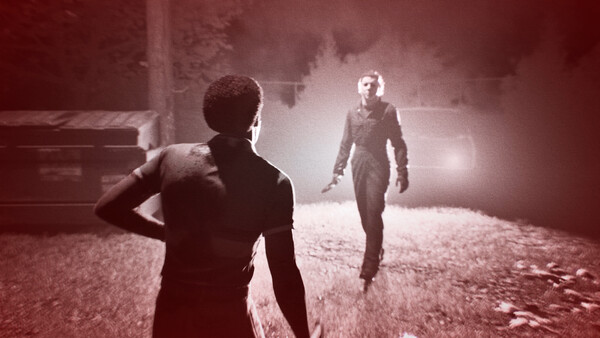
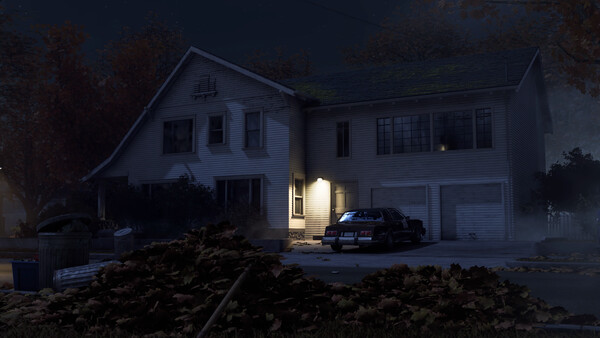
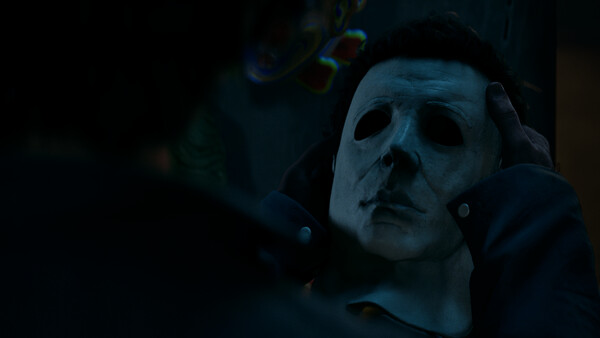
Presentation is where the game earns most of its goodwill. Streetlights, autumn leaves, jack-o'-lanterns, and the cold blue-black night sky capture the look of the source material with obvious care, and the recognisable homes and interiors will land immediately for anyone who knows the film. The Shape's unhurried walk, head tilt, and blank mask are animated convincingly, and the audio work leans heavily on Carpenter's minimalist piano motif and long stretches of unnerving quiet.
That quiet is a design choice as much as an aesthetic one. Sound cues matter for both sides, and the deliberate pacing means a distant door slam or a scream from a neighbouring house carries real information. Survivors who play with headphones will have a meaningfully better experience than those who do not.
The trade-off is that the mood can tip into monotony in longer sessions. Because the setting is intentionally narrow, every match takes place in the same neighbourhood under the same night sky. Fans of the film will appreciate the consistency; players looking for the visual variety of a multi-map service game may find it wears thin faster.
Performance, Stability, and Online Experience
Technically the game is a mixed bag. On current-generation consoles and reasonably specced PCs the frame rate is generally stable, but the launch period saw the familiar asymmetric-genre complaints: long queues for players who want the killer role, occasional lobby disconnects, and matches that fail to start cleanly when a player drops during loading. Rubber-banding and animation hitches during grabs and kills were also reported and have been the target of early patches.
Matchmaking balance is the more persistent issue. Because far more people want to play Michael than want to play survivors, wait times for the killer role can stretch considerably at off-peak hours, and survivor lobbies sometimes fill with players who queued for the other side and are not fully invested. Cross-platform play helps keep queues moving, but it does not solve the underlying demand imbalance.
IllFonic has a track record of supporting its licensed asymmetric titles for a long stretch after release, and the early patch cadence suggests the same approach here. Prospective buyers should expect the online experience to improve over time, but anyone who wants a polished, friction-free product on day one should temper their expectations.
Content Depth and Longevity
At launch the package is lean. There is a single town environment with variation in which houses and routes matter from match to match, a modest survivor roster, and a progression system that unlocks perks and cosmetic options for both sides. The depth comes from mastering the two roles rather than from a large volume of maps or characters.
For players who enjoy learning a system, that is enough for dozens of hours, particularly because the survivor objective is more open-ended than in comparable games and Michael's stealth-first playstyle has a real skill ceiling. For players who measure value by the amount of content on the menu screen, the game will feel thin next to established live-service rivals that have accumulated years of additions.
The longer-term outlook depends on the post-launch roadmap. Additional locations, new survivor characters, and variations on the Shape are the obvious levers, and the game's fate as a lasting multiplayer title will hinge on how quickly and how substantially those arrive.
Verdict: How It Compares and Who Should Buy It
Measured against the genre, Halloween sits closer to The Texas Chain Saw Massacre and IllFonic's own Friday the 13th than to Dead by Daylight. It prioritises slow, tense, film-accurate horror over fast competitive play, and its town-alert objective gives survivors more agency than a simple generator race. It lacks the sheer breadth of Dead by Daylight's roster and maps, and it launched with the same rough online edges that have dogged nearly every title in this space.
The game is an easy recommendation for fans of the original film and for groups of friends who already enjoy asymmetric horror and want something built around atmosphere rather than meta-chasing. Solo players who mostly want to be Michael should be aware of the queue times, and anyone burned by previous thin-at-launch asymmetric games may prefer to wait for a content update or a sale.
Taken as a whole, Halloween: The Game is a strong, respectful adaptation with a genuinely clever core idea, held back by launch-window stability problems and a limited amount of content. It is worth the money for its intended audience today, and it has the bones to become a much stronger value if IllFonic sustains support as it has with its earlier licensed titles.